Blue Bell the best ice cream in the country

When I was little and my family would sit around the table at dinner time, my dad would have us all engaged in a competition for ice cream dessert. Although everyone always got ice cream, we competed fiercely for Dad’s approving nod as to which of us came closest to matching the pitch, tone and rhythm of the Blue Bell ice cream commercial. You know, the classic one that goes…Blue Bell, the best ice cream in the country. We usually all had to take several runs at it before we could enjoy our Blue Bell ice cream.
My dad is a really good singer and no one could ever quite match his tone but it was fun to try and even more fun to anticipate eating our ice cream. In the end, like most of the games we played, my parents found a way to make winners of all of us.
Driving home from our Spring Break in Lost Pines (near Austin) my husband and I took our two small children on a little detour to go to Brenham to tour the Blue Bell Ice Cream Factory. I love educational family field trips and this was one that everyone was very happy about!
Exploring my home state is forever an adventure. Texas is so big that there is always a hidden jewel somewhere. The Blue Bell Ice Cream factory in Brenham is one of those precious jewels. On the way to Brenham I was singing…
You scream, I scream, we all scream for ice cream! and Ice ice baby, Vanilla ice ice baby…
 
 
The ice cream making process at Blue Bell is satisfying to watch like lawn mowing, a car wash, or shoe polishing. It is mesmerizing to watch the cartons spin and see the ice cream so carefully poured in.
When we were there on a Wednesday afternoon, the little creamery was making three flavors: Banana Split, Homemade Vanilla, and Strawberry. We also watched them make ice cream sandwiches that day.
Our tour guide, Abby, told us many interesting facts. She asked us if we knew which color rim of ice cream cost more- the brown or the gold. Of course, we all would assume gold, but it’s the brown because the ice cream with a brown rim has more nuts, fruit, or fluff inside. She also asked us if we ever have a hard time taking off the lid, which everyone on the tour said yes too. Abby said it was because they flip the cartons upside-down and that causes an airtight seal.
Abby said there was a woman who wrote a letter to Blue Bell to ask them to make her favorite ice cream that they stopped making and because of the letter, they brought it back. This reminds me of my husband’s favorite flavor, Carmel Sunday Crunch! He was obsessed with it and would buy multiple cartons at a time. It was a staple in our freezer. When he found out that Blue Bell brings flavors back, this made him very happy!  
When Abby told us that they disassemble all the pipes and machines every day to clean them, my jaw dropped. She said it takes about four hours to clean. The Blue Bell employees’ have that down-home dedication that that starts with personal pride, results in company pride, and culminates in community pride. You can see it all over the small town of Brenham.
One of the most respected companies in the region and the country, Blue Bell started out making butter in 1907 because its original business was purchasing excess cream from dairy farmers. Later, as they branched out by making ice cream; delivery boys would hitch up a horse and buggy and rush the ice cream to nearby families where they ate quickly, before it melted. In 1930, the company changed its name to Blue Bell Creameries (named after the Texas Bluebell wildflower that blooms during the hot summer months).
Blue Bell is the third best selling ice cream (behind Dreyer’s and Breyers) even though it’s sold in only twenty states. They employ more than 2000 employees’ at all three plants:
  1. Brenham, Texas
  2. Broken Arrow, Oklahoma
  3. Sylacauga, Alabama

The very best part of the tour was ending at the ice cream parlor to get our own serving of Blue Bell. Picking between twenty flavors, both my children couldn’t wait to try Cotton Candy (a blue and pink candy cloud that tastes just like cotton candy). My husband and I enjoyed the new Rocky Mountain Road (like Rocky Road on steroids)! It’s a rich, dark chocolate ice cream combined with dark chocolate-coated peanuts, milk chocolate-coated pecans, white chocolate-coated almonds, and roasted walnuts, all surrounded by a flavorful marshmallow sauce swirl…one taste and you’re hooked!
I read Judy Blume’s Superfudge every year to my second graders and always laugh when three-year old Fudge Hatcher suggests Baskin Robbins makes “worm ice cream” for an ice cream flavor contest suggestion. Blue Bell does have contests where future ice cream mixologists can enter their own flavor and hope it wins. What suggestion would you give to Blue Bell?
March Rotational Flavors:
Butter Crunch
Cake and Ice Cream
Caramel Turtle Fudge
Cherry Cheesecake
Chocolate Chip
Chocolate Covered Strawberries
Chocolate Mud Pie
Coconut Fudge
Dessert Trio
Mocha Almond Fudge
Rocky Mountain Road
Strawberry Banana Pound Cake
Tin Roof

Putting on the FEED bag


Particularly if you grew up around horses, you may have heard the expression “putting on the feed bag.” It’s a colloquialism that is normally used to describe the self indulgence associated with overeating. I have learned of entirely different use for a feed bag…
My friend Jen doesn’t know it yet, but I’ve already bought her a birthday present that I know she’ll love. Jen is one of those moms who always tries to feed her children the very best foods. Every time I see Jen she is “feeding” her children, she literally has snacks up her sleeves! I know she will love to know that her new bag will help feed children nutritious school meals through the United Nations World Food Programme (WFP).
My two children (three and five years old) absolutely love going to the grocery store with me and picking out what they want to eat. To have food on hand any time, any where is a luxury that we easily take for granted.
I don’t think of twenty-seven year old Lauren Bush Lauren as a celebrity, but a beautiful angel from Texas who like Jen, cares about feeding children.
Lauren Bush Lauren (granddaughter of former President George H. W. Bush) is the Co-Founder of FEED Projects. Born in Denver, Colorado and raised in Houston, Texas. Lauren is a former model and graduate of Princeton with a B.A. in Anthropology and certificate in photography.
She was part of a group of college students that the U.N. sent to ten countries: Guatemala, Cambodia, Lesotho, Sri Lanka, Chad, Tanzania, Rwanda, Kenya, Uganda, and Honduras to learn about poverty and hunger firsthand. After returning to the states, she was inspired to design the “FEED 1 bag” which feeds one child in school for one year through WFP. It’s a brilliant idea because it tells the shopper exactly how they are helping by calculating the number of meals that are being purchased for children in need.
FEED has donated over $6 million dollars to the WFP’s school feeding program, which equates to over 60 million meals to school children.
FEED is a small team of five. They make great products that help people who really need help. The FEED bags are chic and fashionable and go a long way to advance a well deserving cause. The bags are made of burlap- which is (as you would expect) used to transport food. All the FEED bags (even one designed by Judith Leiber) have that rustic FEED quality. Buying a FEED bag, the consumer knows exactly what impact their purchase will have.

Lauren’s recent wedding to Ralph Lauren’s son, David Lauren, was similar to the style of the FEED bag...rustic! Their wedding was a retro-ranch style wedding. They were married at his family’s 17,000-acre Double RL ranch in Ridgeway, Colorado. The pictures look like an old western film. Vogue magazine cleverly called their marriage a “Western Union!”Her hand embroidered ivory gown (designed by Ralph Lauren) had a Little House on the Prairie feel to it with puffy shoulders and a high neck. It took 3,000 hours to hand sew.
I have read that Lauren doesn’t plan to slow down on her good work any time soon. I just imagine she will only do more good once she has children of her own. Being a mother just makes your heart grow.
We all want to help like Lauren; sometimes we just need a little guidance.
It’s the same with children. They are just as anxious and willing when given the chance to help. When given a little guidance they too can get involved in helping end world hunger. I love to take my second grade classroom to the computer lab to get on the site www.Freerice.com which is a non-profit website run (like FEED Project) by the United Nations WFP. The site provides education in an interesting and attention holding way and it helps to end world hunger by providing rice to hungry people for free.
The FreeRice motto is “improving your education can improve your life.” My children know that somewhere in the world, a person is eating the very rice that they helped provide, and that makes them feel so good. It’s a win win! I can take my class to the computer lab to feed their minds and they simultaneously gain global perspective and the pride and satisfaction that comes with knowing that they have helped to feed a lot of people- one grain of rice at a time. I hope some of you will find an interest in “putting on the feed bag.”

The Passion for literature and the romance of letters


My friend Pamela gave me a great gift…a very special book that came all the way from Paris’ famous Shakespeare and Company bookshop. A little water damage makes this book even more of a treasure because it’s a paperback that has been loved. The book, 84, Charing Cross Road is easily on my top books ever read list! It’s real people writing letters to each other and developing a beautiful friendship all the way across the big blue ocean…it’s so romantic! 

I’ve always believed in the power of correspondence and I very much enjoy reading books that are a series of letters. Recently I’ve read three books that are a series of beautiful letters: 84, Charing Cross Road, The Guernsey Literary and Potato Peel Pie Society, and As Always, Julia. Each book begins the same way…the characters all receive a letter from a stranger and their correspondence leads to a lasting and true friendship. It is possible to form lasting and deep relationships with people that we have never physically met.

84, Charing Cross Road is a charming book about an outspoken New York writer (Helene Hanff) whose touching correspondence with antiquarian booksellers in London (especially with Frank Doel) develops such a mutually fostering friendship that they become an extended family. Exchanges between Helene Hanff and the Marks & Co. booksellers at 84 Charing Cross Road are all letters and books.
I found the book to be romantic in the sense that their fondness for each other expanded over time, the romance of the cities New York and London are vividly described, the yarn of letters and books flying or sailing across the sea, and there is also a mystery associated with them not officially meeting that I find romantic.
There could have been a potential for romance between Frank Doel and Helene Hanff but I found them to truly care for each other as friends first. There is an unspoken love for each other without ever seeing each other. It’s a real-life love story.
When reading the private letters of Helene and Frank, the reader gets a taste of cultural and social differences that were commonplace in the 40’s, 50’s and 60’s in London and New York.
Their correspondence went on from 1949 to 1969. Throughout twenty years they exchanged Christmas gifts, news of families and careers. There was always an intention for them to meet but something came in the way every time it almost happened.
A lesson to this is that if there’s something you really want to do, do it when you have the chance or you might miss a grand opportunity.
Through Hanff’s book, the reader is reintroduced to all sorts of old classics with her passion for literature and made to feel inspired not only to write a letter to a friend, but to read a book with either a cup of tea (like Frank did in London) or a cigarette and martini (like Helene did in New York).
There was a lovely movie starring Anne Bancroft and Anthony Hopkins that followed the book beautifully. Anne Bancroft is saucy and spirited just like I imagined Helene Hanff to be.
Hanff’s personality is humorous, demanding, witty and sarcastic whereas, Doel is the classic English gentleman. Hanff playfully begins one letter in all caps, “SLOTH: I could ROT over here before you’d send me anything to read.” Toward the end of their correspondence Hanff writes, “Frankie, you’re the only soul alive who understands me.”
If you’re lucky enough to find an edition of 84, Charing Cross Road that comes with the companion book The Duchess of Bloomsbury, you will love reading them back to back.
Another book I recently enjoyed that is also a series of letters and similar and many ways to 84, Charing Cross Road was The Guernsey Literary and Potato Peel Pie Society. Set in post WWII England, it is based around Juliet Ashton, a writer with sharp wit, and a love of books. When Juliet receives a letter from a stranger in Guernsey, a correspondence begins with not just one, but many Guernsey islanders.
One of my favorite quotes from The Guernsey Literary and Potato Peel Pie Society that I completely resonate with is, “That’s what I love about reading: one tiny thing will interest you in a book, and that tiny thing will lead you onto another book, and another bit there will lead you onto a third book. It’s geometrically progressive—all with no end in sight, and for no other reason than sheer enjoyment.”
One last book recommendation that is a series of letters and friendship is As Always, Julia. Julia Child and Avis DeVoto based their friendship on the art of letter writing before they ever met.  I previously wrote about it here. 
All three books are written with warmth and humor. They have in common that they each find inspiration in the letters to each other, not just for their work, but inspiration for their life.
Through the three books the reader will get a sense of how the power of books and letters sustain readers in good times and in bad. The books celebrate letters in the best possible way. I always look forward to seeing what the closing will be. My favorite closing came from Julia Child’s best friend Avis: Lashings of love. Who doesn’t enjoy reading about collecting books and the pleasures of reading?
I wish for you that you have time to read these books but also find time to write to your friends…do it now, don’t wait! 
As for Pamela’s book, it’s meant to be shared with someone else now. I think I’ll send it by mail…with a letter.


The Pen is Mightier than the Whiteboard


Last week, I had the pleasure of attending the TCEA conference (Texas Computer Education Association) in Austin. TCEA is the leading state organization committed to the use of technology in education.
Many of my fellow teachers who had attended previously gave me a forewarning, suggesting that I would be so overwhelmed with the amount of information that my brain will hit overload.

Well, they were right, but I found something I loved on my “brain overload” and couldn’t stop thinking about it. The Livescribe pen amazed me in a jaw dropping kind of way and I thought of a million ways I could use it. The livescribe pen is a tool for securing, manipulating, and broadcasting notes on the go. I thought of ways, not only in my classroom, but for my own children (even for myself). There are endless possibilities…

All week TCEA had drawings to win a class set.  I kept going back to the booth in the exhibition hall asking more questions and watching demos seeing how I would use it. I didn’t win but I filled out several entry slips as I kept thinking of more ways that I could use it: as an ESL learning tool, practicing writing and reading fluency, as a portfolio assessment, giving instructions (cloning myself) so I can be everywhere in the classroom, storytelling, letter writing…

The livescribe pen records what you write, and its microphone records what you’re hearing at the same time. It’s helpful in almost any setting that you want to record something for future reference…lectures, to-do lists, or interviews. The pen is a useful tool for all kinds of professions like lawyers, doctors, journalists, and executives. The field I can see benefiting the most is in education.

I can see older children and college students using the livescribe to record a lecture while taking notes at the same time…I guess you’d call it a pencast! A student can simply select a word by tapping on it and the pen plays back whatever audio it recorded at that point in your writing.

It’s easy to share these pencasts with other people using the Livescribe Web site and desktop software. My class has French pen pals and how amazing will it be to write/translate/and hear students from the other side of the world?

As an elementary teacher the livescribe pen will allow me to teach something once and then my students will be able to learn it anytime and anywhere: the classroom, a review at home, in centers…
Recording yourself with a smartpens is like cloning yourself. Teachers could use sound stickers and audio enhance every book and object in the room. Students not only see the written word but hear them as well.

The pen may well become a genius learning aid for ESL (English as a Second Language) students. For children who are trying to become successful in a new language, it can make a difference in how these students process knowledge. The ESL child can take the pen home and never be out of the loop with homework because they would get the teacher’s exact instructions and proper pronunciation (it’s like taking your teacher home)to help prevent them from falling behind.

When learning about this magical pen at TCEA, I kept thinking of the many benefits of fluency and dictation practice that I’ll be able to provide now. If a child can hear themselves reading, it will improve the student’s manner of speaking and they’ll be more likely to better edit their writing.

The pen has two main features: when you write notes the pen will actually save what you wrote and when you sync it to your computer, all your notes will appear just as they did when you wrote them. You see your handwriting appear on the computer screen in front of you as the audio plays back.  The second important feature is that while you are writing, you can record the audio…its killing two birds with one stone. It’s not a distraction but a learning tool to help you pay better attention.

I can look around my classroom of second graders at certain times and see that there are some students that don’t appear to be getting it. I can clone myself and they can have my lesson again. I have many children who need to hear things more than once. This also gives students more control because they become an active part of the learning process.


All of the notes you create with the pen will sync with your Evernote account so they can really be with you everywhere (like dropbox). Think about: grocery lists, to-do lists, notes, lectures…

We know of many examples in history that have shown us the power of the pen to exceed that of the sword. We may have thought that pens and whiteboards have enjoyed rather equal standing in analysis of educational methods. Now, however in the race of technology to aid education, we may well learn to believe that “the pen is mightier than the whiteboard!”
See these two video examples of livescribe in action here and here.
Ashley at TCEA with the popular robot Moby from Brain Pop giving a thumbs up to technology.

Moulin Rouge: The Ballet

Stepping in to the Eisemann Center in Richardson, Texas on Friday night was an exhilarating feeling. Entering the theatrical atmosphere, the audience saw the signature red windmill lit up and slowly spinning. It made me feel as excited as I was when I saw the Moulin Rouge in Paris. The Royal Winnipeg Ballet set the stage for an evening of pure entertainment…Parisian style.
The Royal Winnipeg Ballet theatre’s artistic director Andre Lewis and choreographer Jorden Morris teamed up to celebrate the most famous cabaret in history, the Moulin Rouge. Moulin Rouge: the ballet is Royal Winnipeg Ballet’s highest-grossing production ever.
The seventy-two year old Canadian ballet company’s of twenty-six dancers made this fascinating time period of the Belle Époque (beautiful era)come alive. The romance and excitement of twentieth-century France could be felt both on stage and en pointe. Ballets usually tell love stories, and what better than a romance from the turn of the century.

Morris’ ballet is the romantic tale of Nathalie (Amanda Green), a laundress, and Matthew (Dmitri Dovgoselets), a painter. It is a love story of two innocent lovers in Paris. Nathalie is discovered by Zidler (Amar Dhaliwal), the owner of Moulin Rouge. Toulouse-Lautrec (Nurzhan Kulybaev) is such a character in the ballet, he was known for his bohemian lifestyle. In the ballet, he was a man who could dance a jolly, jaunty, jig… especially after consuming absinthe.
Toulouse-Lautrec is a bad influence on Matthew and soon he too is drinking absinthe and is visited by three beautiful green fairies who dance with Matthew under a green Moulin Rouge windmill.
Moulin Rouge: the ballet was well composed with beautiful music from famous period artists like Edith Piaf and Claude Debussy. The music flowed perfectly with the period costumes. I also appreciated the authentic nature of the hair being down on some of the gypsy dancers because it was informal and more realistic of that free and optimistic time of the Belle Époque.
Morris’ very witty choreography earns him laughs from the audience with a funny tailoring scene when little gay men bourrée like prissy Barbie dolls on their tiptoes to change Matthew into a man of class. The best part was when the merry men lifted Matthew up and dropped him into his pants. Talk about a quick change!
Morris’ since of humor in his chorography reminded me of the musical The Producers when the doorbell rings in the (very gay) DeBris’ apartment and plays “I Feel Pretty.” It’s that same playful and sexual reference that Morris created to make the audience roar with laughter.
My favorite scene was when Nathalie and Matthew are at a bridge by the Eiffel Tower dancing a romantic pas de deux to Debussy’s Claire de Lune. It is dreamy, lovely, heavenly…and I didn’t want it to end!
The Moulin Rouge’s famous dancers, La Goulue and Jane Avril, were both painted by Toulouse-Lautrec around 1892. Red-headed La Goulue’s audacious behavior can be seen in Morris’ ballet as Royal Winnipeg Ballet dancer, Jo-Ann Sundermeier teased the male dancers. We see her cheeky and edgy movement choreographed in the ballet. Sundermeier is fiery and feisty just as I would imagine La Goulue was in her heyday.
My ballet teacher, Glenda Norcross, often talks about her former ballet teacher, Bill Martin Viscount, who was a Royal Winnipeg Ballet company member. When Glenda is teaching class, she likes to say something she learned from him, “One last time before we repeat the combination.”  A ballet class with Viscount must have been at least three hours long. I imagine the rehearsals for Moulin Rouge: the ballet would have been Viscount-style because it is obvious that the RWB dancers are exceptionally well trained and have heard the Viscount phrase, “One last time before we repeat the combination.”
One of my few complaints Friday night was that the tango scene from the Royal Winnipeg Ballet seemed mild compared to the raw and sensual tangos I’m used to seeing. A tango should be a strong dance of expression and passion. I wanted more emotion from the dancers and more steam from the choreography. But then again…ballet is not usually sensual. The tango was beautiful en pointe but I think Morris could have asked more from his dancers. They certainly had all the components to make it happen…music, costumes, long legs, a backdrop to step back in time to the Belle Époque and an audience that would have been thrilled to see more passion and energy.
Dances like the cancan and the tango are both seductive forms of entertainment that you don’t imagine ballerinas performing. That is why I really couldn’t wait to see this ballet! I love the unexpected...to find the beauty of ballet made less classical and more mysterious is exciting and something that there are few opportunities to enjoy.
The cancan en pointe is something to see. It’s not what you imagine classical ballet to be and certainly not how we might imagine that La Goulue and Jane Avril danced at the Moulin Rouge in the 1890’s.  As much as the ballet dancers disguise themselves as showgirls, the Royal Winnipeg Ballet dancers are ballerinas first.
The Eisemann audience gave Royal Winnipeg Ballet a standing ovation. As I was applauding I was reminded of a quote from Moulin Rouge! (the movie): “The greatest thing you’ll ever learn is just to be loved in return.” I was thinking the greatest thing you could learn would be to appreciate the past and where you are in the present.  Merci RWB!
Watch this video for a taste of Moulin Rouge: the ballet  and this sample of steamy tangos (some from Moulin Rouge! the movie):

The Fashion World of Jean Paul Gaultier: From the Sidewalk to the Catwalk in Dallas


Jean Paul Gaultier has always had an open-minded view of society; exploring and investigating ideas with a grand sense of humor.

Gaultier started his career in 1970 at age 18 as an assistant to Pierre Cardin, and more recently he has been the creative director of Hermès from 2003 to 2010. Gaultier is known for using unconventional models for his exhibitions like full-figured, older women, and tattooed models as well as conventional models. This is partly why he’s so recognizable and popular as a designer. He has said, “In life, I like the blemishes, scars, emotions of the skin, of the flesh, of movement—everything that is human.” I think he has a special eye to view the beauty of life. He has also said, “Women become beautiful once they become forty.”
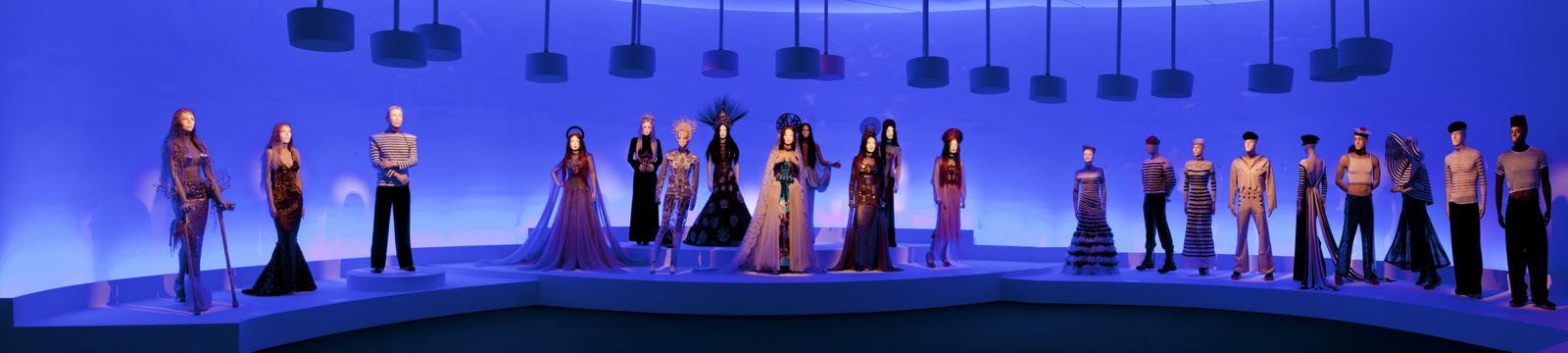
Walking slowly through the Dallas Museum of Art I could hear the soundtrack of Gaultier’s life playing through his six themed rooms: “The Odyssey of Jean Paul Gaultier,” “Boudoir,” “Skindeep,” “Punk Cancan,” “Urban Jungle,” and “Metropolis.” These six rooms feature approximately 130 ensembles from his couture collections.

I imagine his playlist might include some Boy George, Carla Bruni-Sarkozy, Madonna, Kylie Minogue, Amy Winehouse, the soundtrack to Nine and some Cole Porter Anything Goes.

Porter’s lyrics to Anything Goes couldn’t be more parfait for Gaultier!

In olden days a glimpse of stocking
Was looked on as something shocking,
But now, God knows,
Anything Goes.


Entering the energetic atmosphere there are thirty life-like mannequins to great you in first room “The Odyssey of Jean Paul Gaultier” including a mannequin of the “bad boy sailor” Gaultier himself speaking, “Hello, welcome, I am Jean Paul Gaultier. I am very happy to receive you here in the Dallas Museum of Art. Enjoy the show.

I love his choice of real everyday looking women with unusual faces for his cutting edge talking mannequins. He wants for people to see everyone’s beauty. He thinks of fashion as a game and does not call his work “art.” He says, “My job is to make clothes that have to be worn.” I think Gaultier is being humble to not call his couture creations “art”…oui, bien sûr it’s art!

It is such a pleasant treat that more and more museums are welcoming fashion. Dallas has been in the lime light twice now. It was just a few years ago that SMU welcomed Spanish designer Balenciaga. In 2008, New York City’s Metropolitan Museum of Art hosted the Chanel exhibition and more recently the MET also featured Alexander McQueen’s designs.

Although Gaultier says he doesn’t think about a certain time period for his inspiration, he can make you feel like you just stepped back in time or into the future like he did in  The Fifth Element movie.

Museum visitors feels like they could be in the Belle Époque period about to run into Toulouse Lautrec painting Jane Avril doing the cancan. Then he takes the audience to Amsterdam’s red light district in the “Boudoir” room. A cigarette seemed an appropriate thing to have after being in the “Boudoir” and “Skindeep” rooms… et voila, many of the mannequins were holding cigarettes in the next room smoking for the audience on a moving runway oval platform. It’s as if he wanted us to feel the experience and I can just imagine him saying in his French accent, you just had some naughty fun in Amsterdam and now I’m bringing you the 80s London punk scene and then onward to the "Urban Jungle."


My Ukrainian friend found herself drawn to a dress that was a Tribute to Ukraine. The stunning dress took 242 hours to create.
After seeing The Fashion World of Jean Paul Gaultier: From the Sidewalk to the Catwalk  it is certain that Gaultier speaks to all kinds of women. His attitude is that fashion is for everyone. He is playful, whimsical, provocative and imaginative.

What I love about Jean Paul Gaultier is that, like a Picasso, he is easily distinguishable . His style is unapologetic, has good humor, and combines couture with culture.

His artsy, chic, and fashion forward grandmère was his first muse. He played in her closet and was fascinated with the discovery of the corset and wearing underwear as outerwear. He would watch his eclectic grandmother sip vinegar to make herself gasp and contract her stomach muscles and then cinch her corset tighter.


He has been inspired by the streets of London punk music scene, Paris, Folies Beregere, but it was the 40s movie Falbalas that made him want to become a designer. Old movies and showgirls also evoked his passion for fashion.

My mom sent me his first corset bottle perfume when I was in college in 1993 at the University of Alabama. My sorority sisters in the Bible belt couldn’t believe I had such a naughty bottle in my room. The bottle oozed sex! That’s what I mean about Gaultier being unapologetic; his style is “in your face” unique with a side of sex.

He’s had many a famous muse throughout his career: Catherine Deneuve, Helen Mirren, Carla Bruni-Sarkozy, Madonna, Charlotte Rampling…to name a few.

Madonna’s costumes for the 1990 “Blond Ambition" tour was one of the highlights of the exhibition.

Gaultier has always had a thing for sailor stripes; the stripes portray his bad boy “enfant terrible” image perfectly. A name he earned in the 70s for his first fashion show because of his tendency in challenging the then common views of fashion by reworking them exhaling into them the breath of his own ideas.


He’s inspired by movement and does a lot of design for ballet. Most recently he designed costumes for Angelin Preljocaj’s Snow White ballet and his motivation from the movie The Black Swan can be identified in his pieces in the Fall 2011 couture collection.

Dallas has much to be proud of and we have been extremely lucky to debut Gaultier’s show as one of only two U.S. A. stops. After the show ends in Dallas (February 12th), it will travel to San Francisco.  


Jean Paul Gaultier has definitely made his mark on what fashion is today. The Dallas Museum of Art honors him with a tribute to life. C'est Magnifique!     


Bei mir bist du schön: means ‘American Ballet Theatre’ is grand


One of the most beautiful sights you can see in a theatre is the American Ballet Theatre in a live performance. ABT is the country’s oldest surviving ballet company, but the word ‘old’ doesn’t suit ABT. This past weekend the company displayed an exciting mix of traditional and avant-garde in Dallas’ performance.  It was a HUGE honor for Dallas to be graced with their appearance at the Winspear Opera House. After all, it was thirty years ago that they last visited us; so this was an event not to be missed.
We were so lucky to watch the ABT greats of the last several decades including Julie Kent, Paloma Herrera, Misty Copeland, and Jared Matthews. American Ballet Theatre’s Artistic Director, Kevin McKenzie (former Principal Dancer) keeps the company current with an inspired variation of contemporary and classic pieces.
I must admit, I’m a little obsessed with Julie Kent. I think she’s one of the most beautiful women in the world and knowing that she’s the mother of two and forty-three is enough to make me want to bow down and raise my arms up and down.  
I think most people hear ABT and think Swan Lake, Giselle, and Sleeping Beauty but ABT does progressive contemporary ballets oh so well. It feels fresh and right to see a classical ballet company dancing modern. Twyla Tharp, Paul Taylor, Martha Clarke, Merce Cunningham are just some of the modern choreographers that have worked with ABT. 
Company B has the zippy feel of the 1940s with the swinging lindy and fast-paced polka. Listening to the Andrew Sisters brings back the spirit and hopefulness that Americans had during World War II. ABT danced to Boogie Woogie Bugle Boy, Tico-Tico, Bei Mir Bist Du Schön … Paul Taylor originally created Company B for Houston Ballet in 1991. The audience was swaying along with the dancers as they moved to the Andrew Sisters, even singing along…
I could say bella, bella, even say wunderbar
Each language only helps me tell you how grand you are
I've tried to explain, bei mir bist du schoen
So kiss me, and say you understand
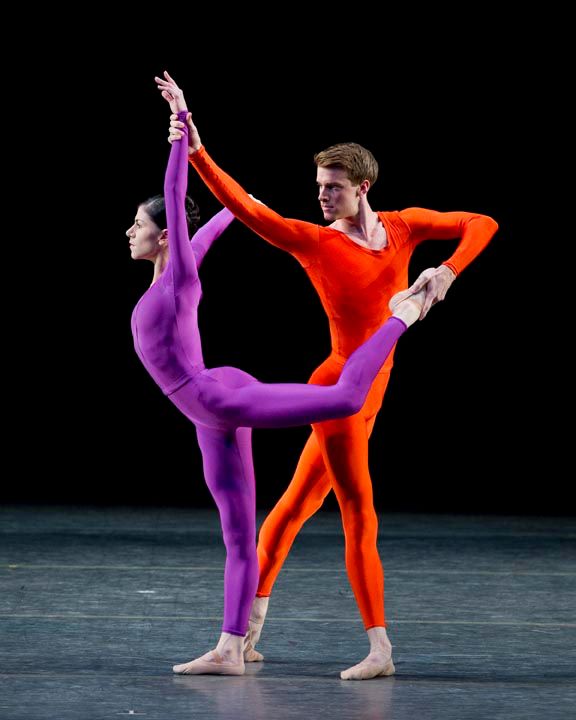
Also on the ABT bill was another modern pioneer, Merce Cunningham who choreographed a set of charming Duets for six couples back in 1980. Duets mesmerized the audience with their abstract but balletic and playful movements. The bold colors of the costumes and movements had a clarity and preciseness that kept the delighted audience thoroughly engaged during the John Cage electronic drumming music.
In Duets, each couple related to one another in a gentle but exacting manner. Watching their bodies, I felt like they had on point shoes because their lines were long and their length kept building with the percussion of the music. The music made me imagine South Africa but the dance style reminded me of Ireland because the arms laid low and the focus was on the power of the lower half. I loved the end when all six duets returned to the stage in a fiery rush of controlled chaos.
I’ve always been fascinated that Merce Cunningham worked without music first. True to Cunningham’s form, the piece Duets was rehearsed without music and to keep the ABT dancers on their ‘modern’ toes, the music was mixed into eight variations so they wouldn’t get in the habit of predicting the music. Merce Cunningham only recently passed away in 2009 so it was a lovely tribute to him and helps keep his dance alive.
Ratmansky’s Seven Sonatas is what most people imagine contemporary ballet to be…free, flowey, and fresh. The pure white costumes matched the emotion of the piece. I found myself leaning into the stage and moving toward the dancers. The pianist, Barbara Bilach, was on stage with the dancers and only increased the mood. You can’t beat live music.
Alexei Ratmansky (artist in residence) choreographed this beautiful piece that made the audience gasp with delight. It was delicate and flirtatious. Julie Kent played the perfect coquet as she teased Alexandre Hammoudi then abandoned him on stage. He kept looking back to see if she was watching him dance. When she reappeared, she pointed to him and he shook his head yes. The art of flirtatious gesturing made Ratmansky’s Seven Sonatas my favorite performance of the night.
Balanchine’s Tchaikovsky Pas de Deux from the 1960s was breathtaking with the lovely Paloma Herrera. She is faster that a jackrabbit. Tchaikovsky’s music was originally meant for Swan Lake and this Pas de Deux is a little treasure that almost never happened due to a cast away Tchaikovsky piece.
With ballet, everything is up, light, and effortless; modern dance is the opposite, with everything being grounded into the Earth. To have ballet dancers dance modern was a pleasure for the eyes as well as the soul. As with everything, you must go down to go up. Classical modern is my favorite style, it’s just beautiful! I really admire the ABT dancers in this performance because it is exceedingly challenging to switch from ballet to modern in the same show.
As the audience retired, the Andrew Sisters song, “I Can Dream, Can’t I” happily stuck in our heads…For dreams are just like wine, and I am drunk with mine. Thank you ABT, for the pleasure of leaving the Winspear intoxicated by the champagne of ballet. Please don’t wait another thirty years to return. Bei mir bist du schön!

Caravaggio and His Followers in Rome...with Children


When I take my children to the museum, I wing it. I think it’s almost better to not have a plan and just have the attitude that you’re going to see what you can see as long as the kids can last. I love to be led by my children and see what artwork they gravitate toward. 
My mom and I recently took my son and daughter to the Kimbell Art Museum’s Caravaggio exhibit. Caravaggio and his followers in Rome was one of those monumental exhibits that was a must see before it ended.  The fifty plus paintings were shown exclusively at the National Gallery of Canada, Ottawa and Fort Worth’s Kimbell. It was only the third exhibit of Caravaggio’s work ever displayed in the United States. It was amazing to see so many of his paintings together since only about seventy-five exist.


Caravaggio (1571-1610) was an Italian artist who created for private collectors in Rome. His paintings have a way of telling a story with everyday people that even children can be curious about. The dramatic funny faces, card games, and dreamy look of his characters draw you in and make you wonder… "are they like me?" He also painted many religious scenes of beheadings and blood that my mom and I quickly viewed then went onward to baby Jesus. Caravaggio’s realistic paintings of interesting facial expressions made my children laugh out loud.
Simon Vouet’s theatrical response to Caravaggio’s Gypsy Fortune Teller  The Fortune Teller, 1620

We saw many children viewing the Caravaggio exhibit with their parents. Not all museums are child friendly. Lucky for us, there are many museums in the United States that are. There is usually a hands-on kid’s area in most museums in America. You really can’t say the same for museums in Europe.  How nice for my family that we have two very child friendly art museums in the North Texas area, the Dallas Museum of Art and Kimbell Art Museum. Both museums have family festival events and encourage young children to come explore art-making activities, see live performances, and simply make the museum a happy place that children will want to visit again and again. The Kimbell has a family fun day event coming up February 18th.
When visiting a museum with young children and there are too many tall adults blocking the art, parents have an unwritten permission to cop-a-squat with their little one in the front and see art from their perspective. I liked asking my children questions to get them to think out loud. I asked them: Is that man grumpy or happy? What game are they playing? Can you find an animal? I notice that children always recognize other children their age. My little boy would point and say, “Look Mommy, there’s a kid like me” and “Mommy, they’re playing cards.”


 Kimbell's own Caravaggio, The Cardsharps, 1595

I have always felt museums to be powerful learning environments that give children opportunities to explore, observe and experience art. Children get to choose what to look at, and they leave with the pictures stored in their heads. The memories they created are filed for future reference. Museum experiences help provide children with knowledge and understanding of the world all while gaining an appreciation for art.
Today we can see many different settings in which there is an attempt to morph into a museum. A real museum experience to me should be in a real museum, not like those efforts you may see in a fair-like setting.
When I visit an exhibit, I’m always amazed that no two paintings are exactly alike. There may be a change of light or seasons… I think of Claude Monet and how he experimented with light. It’s fascinating to me how each of his paintings, similar though they may be, have a different feeling or warmth to them.

The Kimbell houses my favorite Henri Matisse, L'Asie, 1946
Looking for inspiration? Here’s a list of children’s books about art and going to the museum:
Jane O’Connor’s Fancy Nancy at the Museum
Blue Balliett’s Chasing Vermeer
Arlene Boehm’s Jack in Search of Art
Lisa Jobe Carmack’s Philippe in Monet's Garden
Elaine Clayton’s Ella's Trip to the Museum
Don Freeman’s Norman the Doorman
Jacqueline P. Weitzman’s You Can't Take a Balloon into the Metropolitan Museum
Cristina Bjork’s Linnea in Monet's Garden

Nina Laden’s When Pigasso Met Mootisse


The Kimbell houses one of my favorite Matisse paintings that I always look forward to revisiting when I’m there. I loved sharing it with my children for the first time. When we left the Kimbell, they yelled out, “Bye Matisse, we’ll see you later!” And…we will!